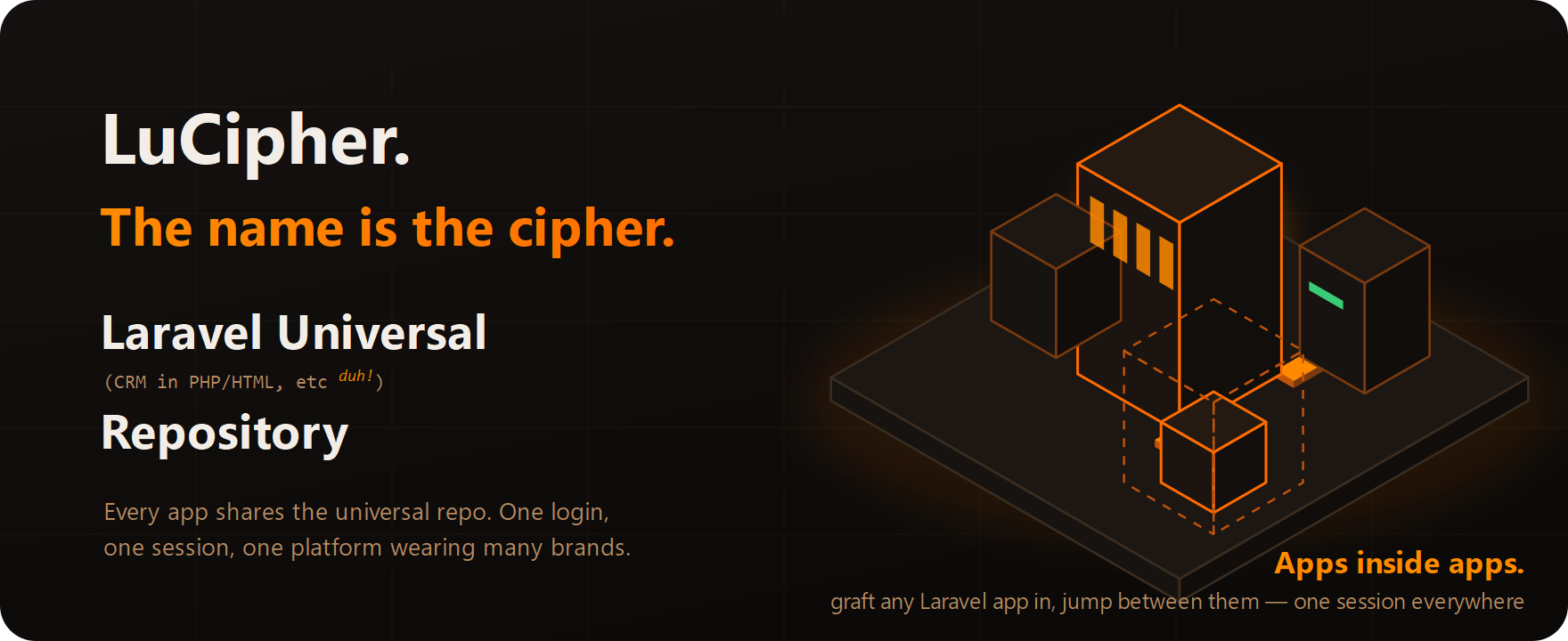
Everything below this line is downstream of one idea. Laravel is treated as
the All Mind: a single mind that corresponds to itself, and
is made of multiple Laravels inside the same project. Not a framework
running an app — a framework running itself, at more than one scale
at once, where the shape you find at the top is the shape you find at the
bottom.
That is the law of correspondence — as above, so below — applied
until it stops being a metaphor and starts being a build. The seven laws it
belongs to are written down separately, on their own page, deliberately kept
free of any framework so they outlive this one.
The mechanism is literal. One document root, one PHP process: a request
arrives, and the application it lands in boots a sibling Laravel's
autoloader and bootstrap file in place and runs it — Laravel
inside Laravel, no iframe, no CORS, no internal HTTP hop. Two questions are
answered before any of your code runs: which application am I,
resolved from the filesystem, and whose install is this, resolved
from the domain that reached us.
A fleet of separate applications then behaves as one product, and the engine
underneath stays one codebase serving them all. That sentence is the law
restated in plain English: the same structure at the fleet scale and at the
single-app scale, agreeing, or the seam shows.
And it is not a demonstration. Every application I have built for
myself, and the infrastructure of my own companies, runs on LuCipher.
I live in it daily; that is the only claim about it I would call proof.
neo@neonos: ~
neo@neonos:~$ lucipher --resolve
app : from the filesystem
install : from the domain
boot : sibling laravel, in-process
hops : 0
neo@neonos:~$ lucipher --what
philosophy first · implementations second
neo@neonos:~$